Category: History

  • The Forest For The Trees

    “Nothing is holier, nothing is more exemplary than a beautiful, strong tree. When a tree is cut down and reveals its naked death-wound to the sun, one can read its whole history in the luminous, inscribed disk of its trunk: in the rings of its years, its scars, all the struggle, all the suffering, all the sickness, all the happiness and prosperity stand truly written, the narrow years and the luxurious years, the attacks withstood, the storms endured. And every young farmboy knows that the hardest and noblest wood has the narrowest rings, that high on the mountains and in continuing danger the most indestructible, the strongest, the ideal trees grow.” – Hermann Hess

    This is the time of year when I slightly resent the trees around me.  I recognize the love/hate relationship I have and let it be.  The trees that surround me offer shade and shelter and song.  For these things I’m most grateful.  But they also offer a level of constant maintenance that wears me down at times.  The trees want to reproduce, and so they cast thousands of seeds and clouds of pollen at the time when I’m most eager to just be at ease for awhile.  And then just when I grow fond of them again we do it all over again in the fall with leaves and acorns and hickory tree nuts.  Nobody said it would be easy.  But I’ve chosen this place by the edge of the woods to live.  The trees were here first and I learn from them while they tolerate me.

    Those farmboys Hess writes about were cutting down that hardest and noblest wood to build sturdy ships and homes and barns and furniture.  Walk into an old Colonial-era home built three hundred years ago and look at the wood that makes up the structure of that building.  Look at the floors.  This was old growth lumber, not the young fir and pine forested today.  Today’s lumber is from relative teenagers by comparison.  And we know how teenagers can be: mind of their own, and they appear strong but are a bit fragile inside.  Nothing toughens you like enduring time and hardship, as Hess points out.  And we’re all enduring a bit of that now, aren’t we?  But it’s nothing compared to what our ancestors went through, and its good to look back on history and the hardships that our grandparents and grandparent’s grandparents endured.

    Still, we’re being tested nonetheless.  And like the tight rings that mark challenges that tree endured, we’ve slowed down in 2020, turned inward and are weathering the storm as best we can.  The collective memory of this will mark a generation, just as those trees clustered on a mountaintop somewhere collectively endured.  But when you’re in the middle of it its hard to see the forest for the trees, isn’t it?  Those tree rings offer another lesson though, for after enduring hardship for a season or several seasons the trees experience a period of rapid growth and the rings widen again.  This too shall pass, and we’ll once again begin a period of sustained growth and recovery.  Everything has its season.
     

  • I Wonder About Such Things

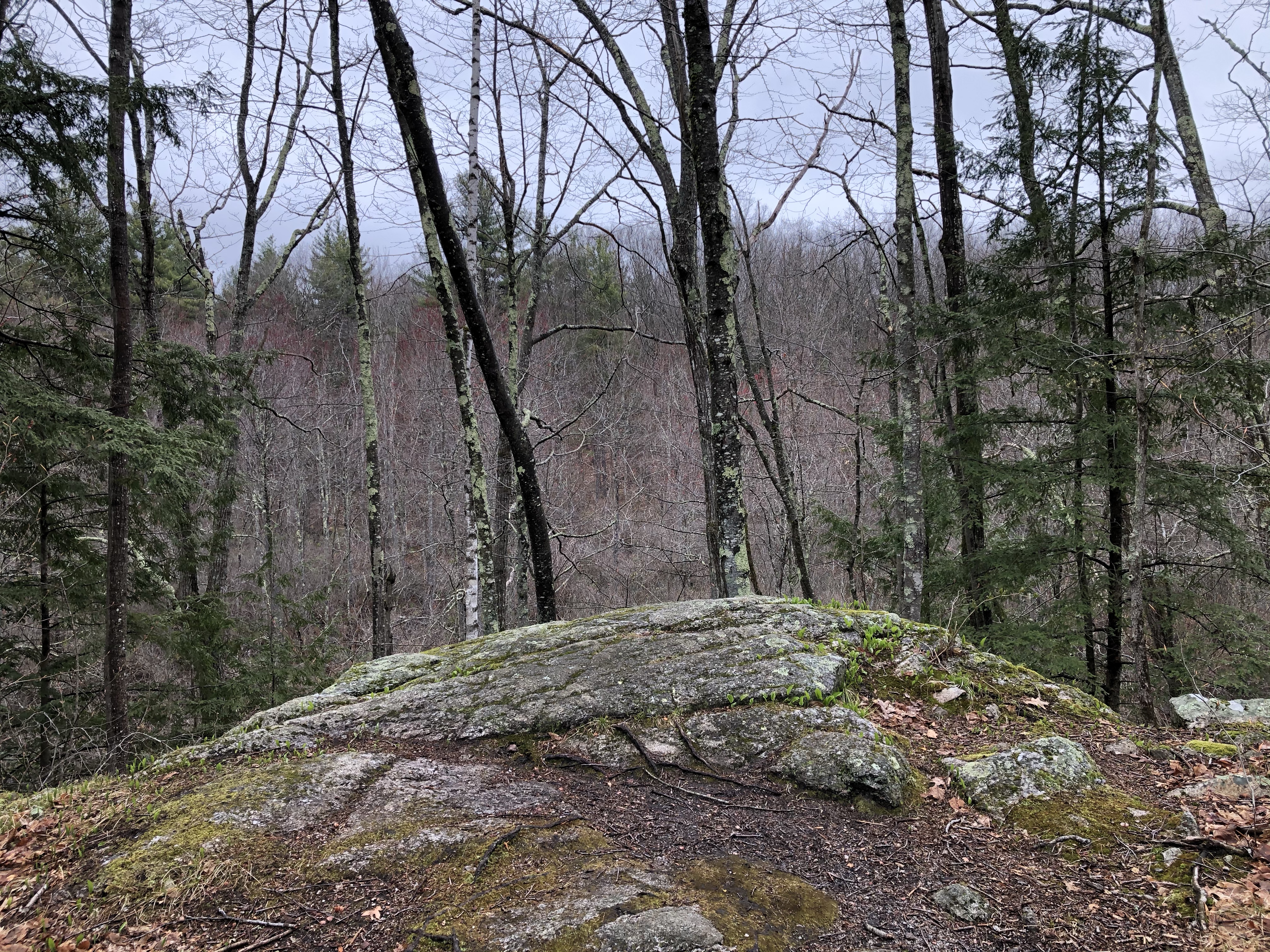
    Who stood here, on this foot-worn knob of ledge looking out on the valley below? Not just today, but one, two or three hundred years ago? I wonder about such things.

    One hundred years ago a young couple, riding up from the mills of Lawrence or Haverhill, getting out of the city for some country air. This spot would surely be an attractive picnicking spot for quietly plotting their future together. A mixture of plowed fields and young forest creeping back in. A fine spot to debate the wisdom of the start of Prohibition or the long-overdue right to vote for women.

    Two hundred years ago, a farmer surveying the land for as far as his eyes could see all plowed fields and grazing land fenced in with large stone pulled all too frequently from the soil. Did he think about his stone walls cross-crossing the land marking his time here long after he left this earth? It was a hard life working the rocky soil. This ledge might have given him a moment’s rest in a lifetime of long, grinding days.

    Three hundred years ago, this ledge might have offered tactical advantage for the Abenaki still fighting for this wilderness of old growth forest. This high ground offered a place to ambush a hunter up from the settlements. But by this time they’d been driven further north and west, and this wilderness would soon be transformed wholly, as the entire continent would be. The Abenaki surely saw the threat of encroaching settlements. Could they imagine all the changes that would come?

    I wonder about such things now, as I stand with ghosts on this ledge, hearing their whispers. It is indeed good land, slowly returning to its original state. This ledge could tell her secrets given the chance. And now I’m just one more story, standing atop an old knob of granite, thinking I might live forever, but the ledge reminds me of the folly in that belief.

  • Spring Fever and Old Graveyards

    Today the feeling stirred up and washed over me in a wave.  An eagerness to explore old places, brought on by reading about historic events 350 years ago.  I get like this.  Really, that’s where this blog started, and will return again when the world returns to normal and I’m up to the task.  Anyway, I was sparked with inspiration and wanted to jump in my car and drive immediately to old battle sites and places of significance that I’ve largely ignored until this feeling flushed the indifference away.  I’m eager to get to it already.  Damn you COVID-19.

    This is my history geek version of spring fever, this stirring, this desire to get out and see things with my own eyes rather than rely on history books and Wikipedia.  It makes me appreciate the freedom of movement I’ve had for most of my life.  For many people around the world this freedom of movement isn’t available.  I’m grateful for the odd assortment of ancestors and events that plopped me down in this place, in this time, with relative good health and a small dose of usable intelligence to productively exist and to peacefully coexist with others.

    I can’t responsibly travel far, but I can travel locally and maintain appropriate social distancing.  And I know the perfect places to visit – those nearby graveyards and old burial grounds.  Those who came before aren’t carrying COVID-19, and they’re safely maintaining a six foot boundary from me anyway.  There are lessons in graveyards, some of which I’ve explored before on this blog.  Graveyards offer their own version of travel in the form of time travel. There are plenty of stories close to home engraved on those headstones, and the land itself is largely the way it’s been for as long as the graveyard has existed.  I need to be outside more, and those permanent residents need a few more respectful visitors. A win-win it seems to me. And a sure cure for spring fever.

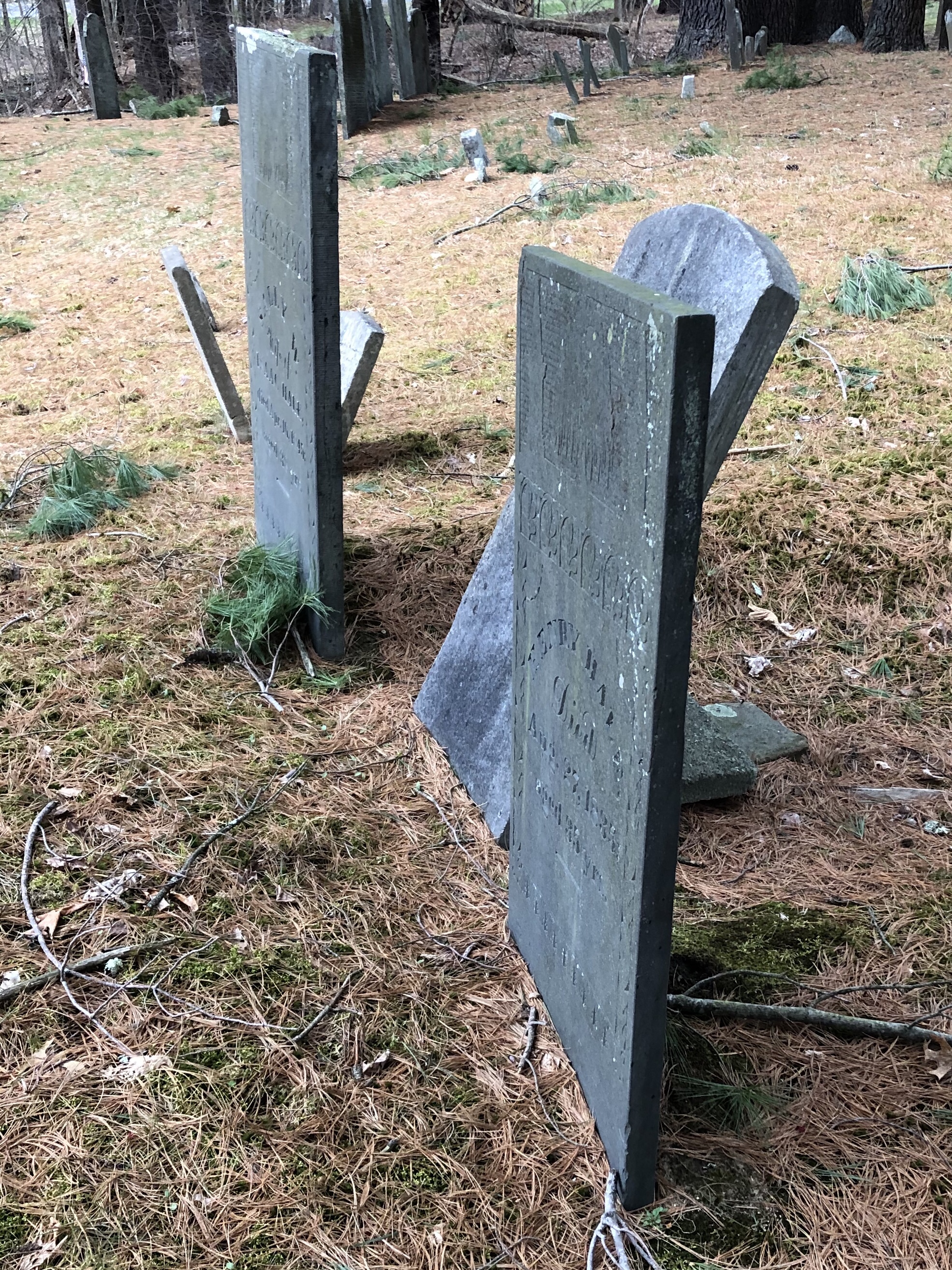
    So with that in mind I took a walk in the light, cold rain half a mile down the road to a graveyard occupied by people buried here during the early 1800’s to about 1885 or so, or put another way, roughly during the lifetime of Ralph Waldo Emerson. Maybe he knew someone buried here, but the 27 miles between that graveyard and Concord, Massachusetts might as well have been a thousand miles back then. These were farmers, blacksmiths and sawmill workers around here, they weren’t making the trek to Concord or Boston for Emerson lectures. They’d marvel at my quick ’round trips to places that they’d walk all day to get to. And mock me my complaints about not being able to roam freely in these times. They knew far worse than this. I can’t argue that point, thinking to myself as I took my iPhone out to snap a picture I’d upload with this post. Technological leaps they never could have imagined in their time on our side of the turf. Maybe I needed that reminder today. It’s always good to get the neighbor’s perspective on things.

  • Patriot’s Day 2020

    Today is Patriot’s Day in Massachusetts and Maine (once part of Massachusetts). The day marks the commencement of hostilities in the Battles of Lexington and Concord. Traditionally, it’s also the day that the Boston Marathon is normally run, at least when there isn’t a global pandemic anyway. And the Red Sox play a matinee game that caps a four day weekend of baseball. In a normal year anyway.

    Holidays are funny things, and Patriot’s Day is one of those quirky holidays. Growing up in Massachusetts, I came to expect the day off from school. Living in New Hampshire for half my life now, I no longer “officially” have the day off, but I’ve taken it as PTO a few times to track a favorite runner in the marathon or simply to soak up the energy. I wasn’t there in2013 but I’ve been right there many times. And like many I was pissed off at the affront. Patriot’s Day started off marking the start of war. It’s evolved into the celebration of the human spirit against adversity exemplified by thousands crossing that finish line. Today the course is quiet, as it should be. Runners and fans alike will wait until September and – hopefully – healthier days. And speaking of healthier days, I wonder what Patriot’s Day 2021 will bring? I hope something better for the lot of us. In the meantime, stay the course.

  • Lessons in History

    When I read about the Salem witch trials I get angry. Angry at the hysteria of the mob. Angry at the “leaders” of the day, like Cotton Mather who got sucked into the madness. Angry that adults would believe the words of accusers instead of listening to reason. Angry that people died for stupid reasons repeated over and over again. People are a bit too cavalier when they talk about witch hunts today.

    When I read about King Phillip’s War I get angry. Angry at the collective short memory of the sons and daughters of the Pilgrims who were alive if only for the grace of a Native American population that chose to ally with them. Angry at the relentless encroachment on the land and the lives of those who who inhabited it, who happened to be in the way.

    When I read about the Raid on Haverhill I get angry at the senseless violence of it all. Settlers trying to make a living on the only land available to them, suddenly upended by naked warriors killing men, women and children because they had the audacity to try to live on the edge of the wilderness. All taken away in a flash of violence against the living. Repeated over and over again. The tragedy of violence took place on both sides as this country grew.

    When I read about the slave trade, I get angry. The dark history of suffering in the rum I drink, the foundation of liberty in America built on the rights of men, even as the earliest generations of African Americans, Native Americans, Scots-Irish and others worked under the threat of the whip or the noose. Celebrate the grand ideals of the Founding Fathers, but don’t forget the price others paid for the rights and privileges we have today.

    I don’t enjoy being angry when I read these things, but I’m driven by a desire to understand the lives of those who came before us. Those ripples still rock our lives in ways we rarely take the time to understand. History is more than a place name or a question on a quiz. It’s our DNA. Ignore the lessons of history and they tend to repeat themselves. Can you hear the whispers in the land? Learn from our sacrifice.

  • Dry Towns, Blue Laws and Border Crossings

    There was a time, within my time, when towns were well known for being wet towns or dry towns. I’m not talking about the amount of rainfall, but rather whether a town allowed alcohol sales or not. I went to a dry wedding once and marveled at the resentment in the room as people found out about it. Imagine moving to a dry town and realizing it afterwards? Like that wedding people would simply carry in what they’d like to drink. Rules are meant to be broken, aren’t they?

    New Hampshire only has one “dry” town out of a combined 259 total towns, cities and “unincorporated places”.  That town is Ellsworth, a small town just west of I-93 between the Lakes Region and the White Mountains.  There are only 83 residents in Ellsworth, and every one of them of drinking age have to go to another town to purchase alcohol.  I’m guessing there aren’t a lot of restaurants or stores selling alcohol in Ellsworth anyway, but if they have anything going for them it’s that quirky statistic that makes them unique in the state. Live Free or Die indeed.

    Neighboring Massachusetts by comparison has 8 dry towns. It used to be many more in my lifetime, but the trend is downward. Look, even the Puritans drank alcohol, and for generations it was safer than water in those early colonial years when life was hard and cholera was common. The Pilgrims brought beer across the pond and negotiated with Massasoit with aqua vitae. People went straight from the cold church to the warm tavern. Alcohol consumption was common right up to a century ago, when Prohibition crashed the party for the entire country. From 1920 until 1933 the United States was “dry”. But rules are made to be broken, and organized crime and small time bootleggers, rum-runners and illegal moonshine stills came into prominence immediately afterwards.

    Dry towns are bureaucracy in action, or simply inertia. Most dry towns today are in rural, sparsely populated places that don’t have restaurant and store owners campaigning for change. Dry towns are a curiosity now, 100 years after Prohibition, but also a legacy to the cultural and political winds that blew across the country then. Being a wet town kid, I remember going with my grandfather to the bar where he would proceed to drink many beers in tiny glasses. That bar was on the edge of town, and that edge was wet meeting dry. How many people crossed the border over the years to have a couple of drinks and zig-zagged home? Now that former dry town sells much more alcohol than that old wet town. Money talks, and there’s money in alcohol sales.

    Sunday’s were once a sacred day in Massachusetts, with Blue Laws that prohibited the sale of alcohol. So naturally residents drove across the border to states that didn’t have blue laws. New Hampshire’s southern border is dotted with old convenience stores that sold beer to eager Massachusetts residents on Sundays. New Hampshire built liquor stores on the highways for the quick and convenient sale of alcohol to out-of-staters. The Blue Laws are long gone, but “sin taxes” aren’t. People still stop to fill up their trunks.

    So Ellsworth, New Hampshire remains the lone holdout on the dry side of the law. I hope they always will be, as a reminder of where the country was 100 years ago. If we’ve learned anything over the last few years, it’s that the political winds can blow in strange ways, and a few people can impose their views upon the masses given the opportunity. But if Prohibition teaches us anything, it’s that Americans chafe at arbitrary rules and find ways around them. Our forefathers would recognize the debate either way, and marvel at the choices in the liquor stores.

  • Make No Small Plans

    “Make no little plans; they have no magic to stir men’s blood and probably themselves will not be realized. Make big plans; aim high in hope and work, remembering that a noble, logical diagram once recorded will never die, but long after we are gone be a living thing, asserting itself with ever-growing insistency. Remember that our sons and our grandsons are going to do things that would stagger us. Let your watchword be order and your beacon beauty.” – Daniel Burnham

    I sat in a line of cars waiting for a light to change to green to release the compliant flock to pastures beyond. The Jeep in front of me had a vanity plate with “YOLO” and what I’d guess was their age when they bought the Jeep. YOLO is a trendy acronym nowadays, and part of me is glad to see it. Not the self-absorbed Instagram look-at-meselfie! YOLO, but the what will you do with this one precious life YOLO.

    What I like about the Burnham quote is that it gets to the heart of it; what is your contribution going to be? Will it inspire current and future generations or will it sink into the abyss of anonymous whispers? Look, a ripple is a ripple just the same, but what if you could make a real splash while you’re here? Seems like a nice way to cap a life.

    Daniel Burnham was a force of nature back in his time, with his architectural firm designing projects as diverse and continually fascinating as the Flatiron Building in New York and The White City for the Chicago World’s Fair. As a diabetic, he suffered health issues later in his life. He famously learned about the death of his friend Francis Millet when he attempted to reach him with a telegraph as Burnham was sailing east on the SS Olympic while Millet was sailing west on the Titanic. Burnham would also die that year, though less dramatically. By all accounts he lived a large life, filled with big projects that echo across the landscape and our imagination today. I’d guess Burnham, as in his own time, might shake his head at the transactional nature of many projects built designed today, but wonder in awe at the scope of others.

    So what of our own plans? Will their scope awe our grandchildren or will we be a curiosity, a relay runner who once passed the baton to another runner who passed it to them in the short sprint through life? Our sons and daughters and grandchildren will do things that would stagger us. Hell, they already are. That is as it should be. So what is your own magic that stirs the blood of those around you? Make no small plans.

  • Old Fort Johnson

    There’s beauty in serendipity, especially when traveling.  Yesterday afternoon while driving from Rochester, New York to Saratoga Springs, New York Waze sent me off the highway onto Route 67, which is a shortcut that cuts off a good chunk of highway.  The drawback of course is that you’re on back country roads in farm country, but I haven’t met an off-the-beaten-path route that I didn’t want to try anyway.  As a history buff I’ve long circled Old Fort Johnson as a place to visit.  It’s hard to hear the whispers of history when you’re blowing by at highway speeds, so having Waze take me off the highway less than three miles from this historic site seemed, well, serendipitous.

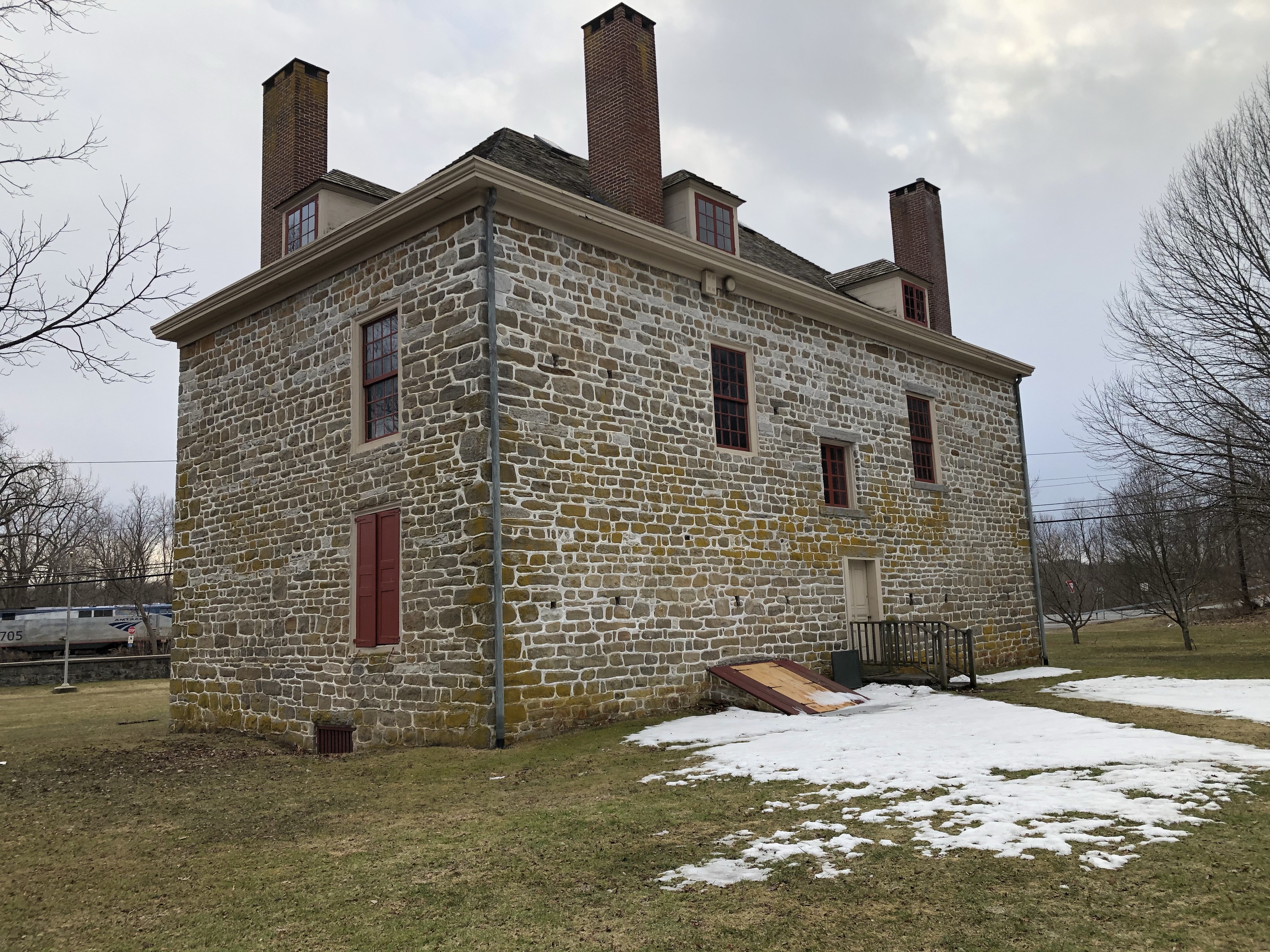
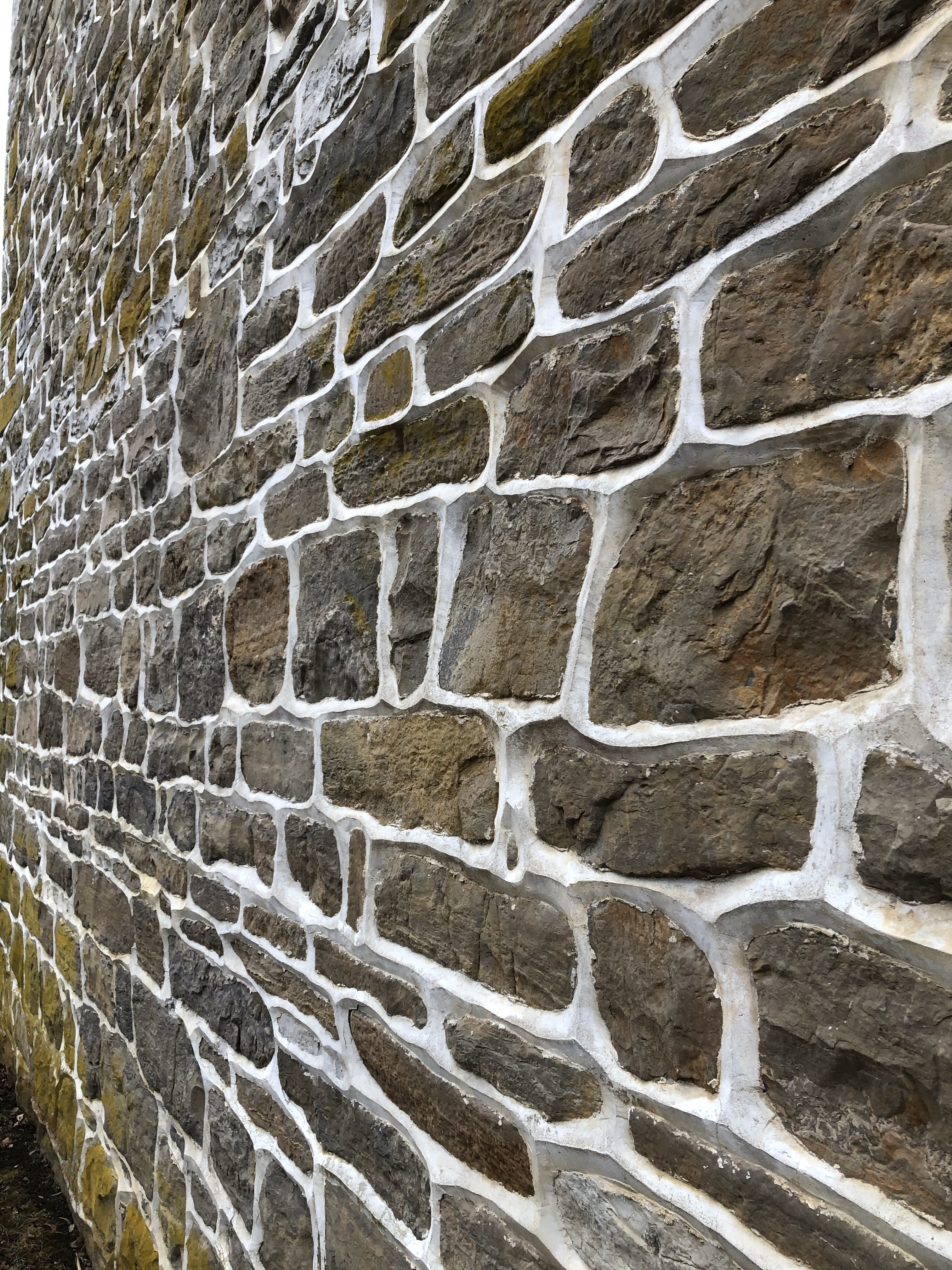
    Here’s the thing, small historical sites like Old Fort Johnson aren’t open year-round.  I’ve experienced this many times over in my travels, but you make the most of the opportunities fate throws your way.  The site is open to walk around, and I stepped gingerly in my dress shoes around the main house doing my best to avoid mud on a wet afternoon.  Sure, I could’ve put on my hiking shoes, which were sitting right in the car, but why dabble in logic when the ghosts are calling?  I walked across the bridge onto the mowed lawn surrounding the historic house, touched the limestone walls and felt the vibration of the colonial history…  or maybe it was the Amtrak train roaring down the tracks between the house and the Mohawk River.

    Okay, this was a quick stop, and not as meaningful for me as visits to battlefields or the homes of poets and writers.  But still meaningful.  This site was where William Johnson settled in a place he called Mount Johnson.  He was a fur trader and as such became friendly with the Iroquois, eventually building enough wealth and influence to be quite a power broker in the wilderness of Upstate New York.  When hostilities with the French broke out, he led the local militia as a Major General and was Commander when the French were defeated at the Battle of Lake George and other monumental victories at Fort Niagara and in Montreal.  In defeating the French at these three key sites, the British would control the waterways to the interior and forever evict the French from New York.

    This large home that Johnson built would eventually be passed on to his son John and other members of the Johnson family.  But here’s where things took a turn.  The Johnson family were Loyalists, and with the outbreak of the Revolutionary War, they chose to fight on the British side just as the Iroquois did.  When the British lost, they were evicted from New York, just as the Iroquois were.  There’s a profound sadness in the history of this place.  Where once there was a thriving collaboration between the Johnson’s and the Native Americans, there was now a void, still felt to this day.  Be careful which side you choose, for you may lose everything you’ve built for yourself in the process.  The house remains a monument to a greater glory, and to all that was lost in the next generation.

  • Palindrome

    02/02/2020 is almost over in this time zone, and it’s worth a mention before it passes by. Read it frontwards or backwards and it reads the same. Surely a novelty of the calendar. It hasn’t happened since 11/11/1111 and won’t happen again until well after all of us leave this planet (probably along with our grandchildren) on 12/12/2121. That’s an interesting date itself, and I wonder what the world will be like in 101 years? A better place or an environmental wasteland? At war or finally, blessedly at peace? The future holds the answer, and all we can do is influence it in some small way. Our token ripple on the pond of history. What shall that be?

  • The Pilgrims and Pokanoket

    As you walk into the Mayflower Pub in London there’s a poster mounted high on the wall that shows the silhouettes of all the pilgrims and servants who sailed on the Mayflower to settle in America. The poster is divided in two, with the upper half showing the Pilgrims as they sailed from Europe. The lower half has the same image, but depicts those who perished before that first winter was over in gray. There’s a lot of gray… but by all rights it should have been all of them.

    The Pilgrims sailed for America too late in the season, without enough food, and sailed for the wrong place. Their charter had them settling at the mouth of the Hudson River, and instead they found themselves at the fist of Cape Cod. Turning south they almost wrecked on the treacherous shoals that have claimed thousands of ships since then. Turning back northward, the Captain of the Mayflower considered present-day Provincetown but eventually worked their way to the area that would become Plymouth., Massachusetts. Pilgrims were starting to die as freezing temperatures, tough living conditions aboard and malnutrition conspired against them. The Native American tribes were well aware of their presence and had already skirmished with them on Cape Cod at First Encounter Beach. A more sustained attack could easily have wiped them out.

    But the Pilgrims also had some lucky breaks that kept enough of them alive to establish a foothold in the region. They arrived at a place where just a few years earlier thousands of Native Americans lived. Contact with Europeans, most likely fishermen fishing the Gulf of Maine, triggered a plaque that killed thousands of people in the few years right before the Pilgrims arrived. So the native population was decimated and in no position to shove the Pilgrims back into the ocean they’d arrived on. They settled in an area with cleared fields and few adversaries. Truly fortunate to be there instead of landing in a place with a thriving and hostile Native American population.

    The other lucky break the Pilgrims caught was landing at a place where the local Sachem, Massasoit, saw strategic advantage in an alliance with the Pilgrims. The Pokanoket tribe Massasoit was Sachem of had been hit hard by the plaque that hit the tribes along the Gulf of Maine, and he was feeling pressure from the Narraganset tribe. An alliance with the Pilgrims gave him some strength in numbers that proved mutually beneficial for the short term. Ultimately this alliance would give the Pilgrims the momentum to survive and grow, but would destroy the Pokanoket in the next generation. An accident of geography brought the Pilgrims and Pokanoket together, time would drive them apart. But in the winter of 1620-1621, it would prove the difference in keeping more Pilgrims from turning into gray silhouettes on a poster 400 years later.